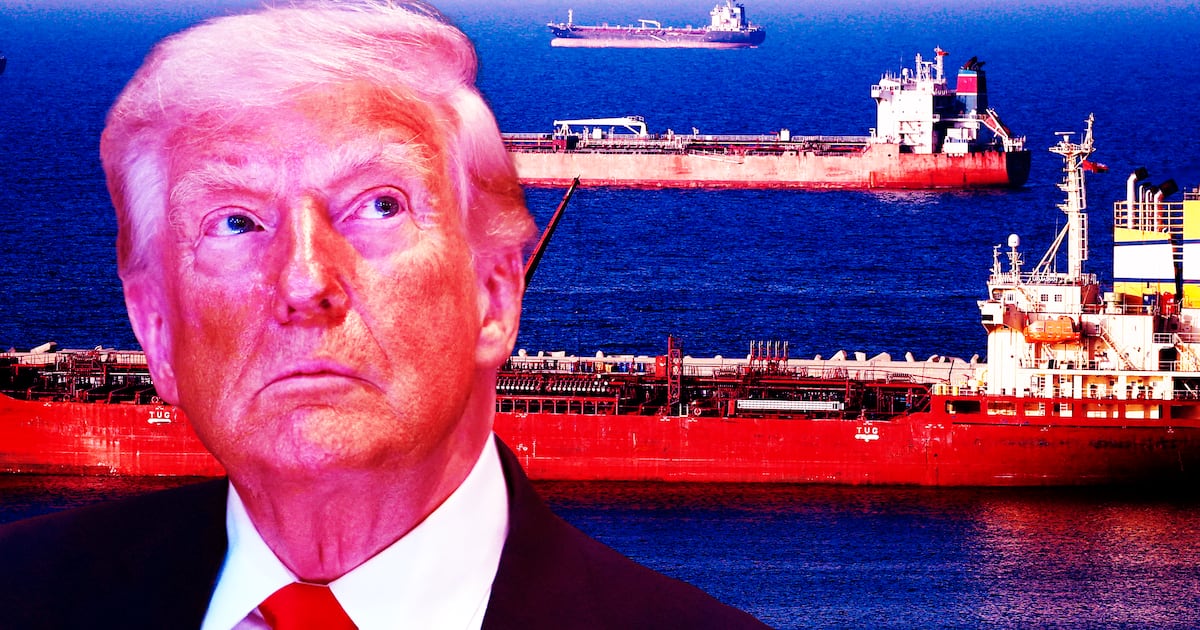

Donald Trump’s latest strategy to ramp up pressure on Iran has been dealt an embarrassing blow after several ships defied his blockade in the Strait of Hormuz.
Multiple Iran-linked tankers—including sanctioned ships and a Chinese-linked tanker— transited the vital waterway within hours of the U.S. Navy’s blockade taking effect.
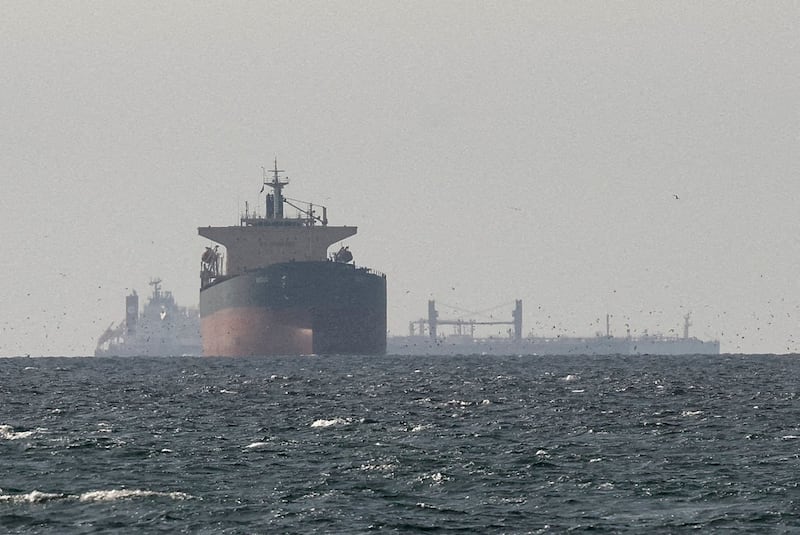
The news raised immediate questions about the effectiveness of Trump’s plan, which began on Monday after the collapse of U.S.-Iran talks in Islamabad.
“Effective immediately, the United States Navy, the Finest in the World, will begin the process of BLOCKADING any and all Ships trying to enter, or leave, the Strait of Hormuz,” Trump declared on Truth Social on Sunday, accusing Iran of “world extortion.”

However, U.S. Central Command insisted on Tuesday that no ships had bypassed the blockade, despite independently verified shipping tracking data showing vessels had passed through the Strait.
A U.S. Centcom post on X also that 10,000 U.S. sailors, Marines, and airmen, along with over a dozen warships and dozens of aircraft, are involved in the mission.
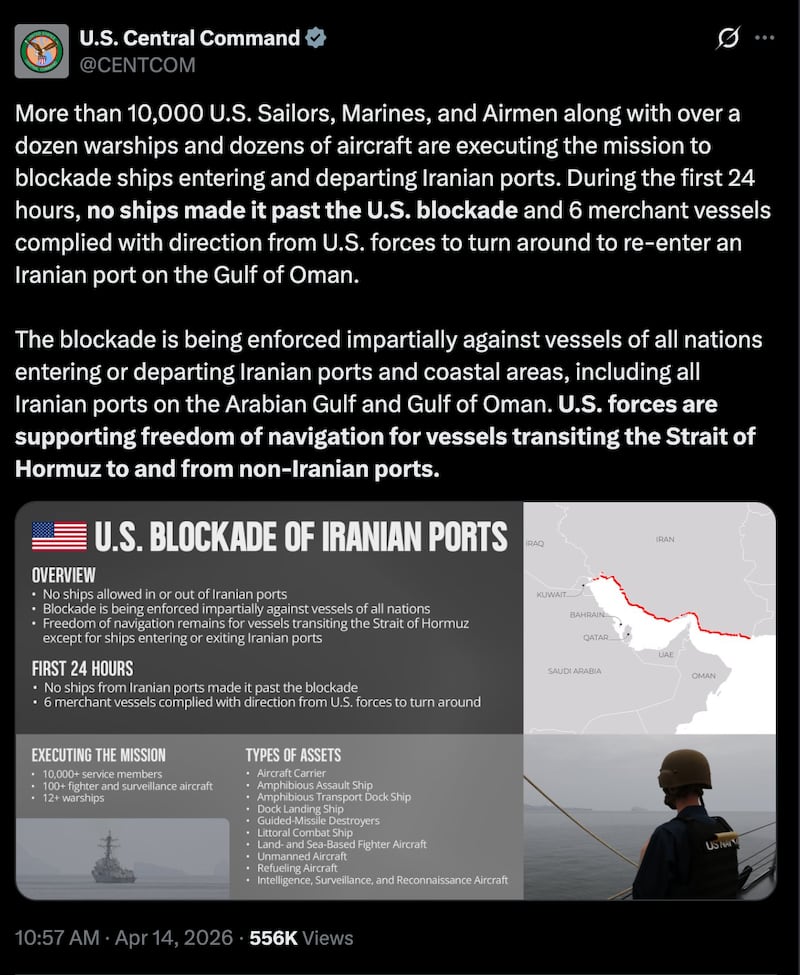
“During the first 24 hours, no ships made it past the U.S. blockade and 6 merchant vessels complied with direction from U.S. forces to turn around to re-enter an Iranian port on the Gulf of Oman,” it added.
“The blockade is being enforced impartially against vessels of all nations entering or departing Iranian ports and coastal areas, including all Iranian ports on the Arabian Gulf and Gulf of Oman. U.S. forces are supporting freedom of navigation for vessels transiting the Strait of Hormuz to and from non-Iranian ports.”
About 20 percent of the world’s oil usually flows through the Strait of Hormuz, but the waterway has been at a standstill ever since Trump began his war on February 28, prompting a global oil crisis and more pain at the pump for consumers.
Even as the blockade took effect, Brent crude, the global oil benchmark, rose 7% to $102 a barrel on Monday while the average national gas price hit $4.12 a gallon, according to AAA Gas Prices.
And in another blow on Tuesday, the International Monetary Fund warned in a report that disruptions to oil markets could continue to slow growth, fuel inflation and raise the risk of a global recession.
“The global outlook has abruptly darkened following the outbreak of war in the Middle East,” Pierre-Olivier Gourinchas, the I.M.F.’s chief economist, wrote in the report.
“The war interrupted what had been a steady growth trajectory.”

The blockade, which began at 10am on Monday, risks setting the stage for a major escalation that could fray an already tenuous ceasefire between the two countries.
Trita Parsi, the executive vice president at the Quincy Institute for Responsible Statecraft, said Iran could respond in several ways, including closing the Strait of Aden, another critical shipping route for oil and trade.
“This would take another 12 percent of global oil flow away from the global markets and it would push up oil prices dramatically,” he said on a briefing call with the Daily Beast.
“Anything at this point that takes further oil away will, of course, push up oil prices in a manner that would be devastating for Trump.”
Iranian officials have also accused the U.S. of violating the truce by allowing Israel to continue to bomb and conduct a ground invasion in Lebanon.
In a bid to ease some of the tensions, Israeli and Lebanese officials began rare direct talks in Washington on Tuesday, overseen by Secretary of State Marco Rubio.
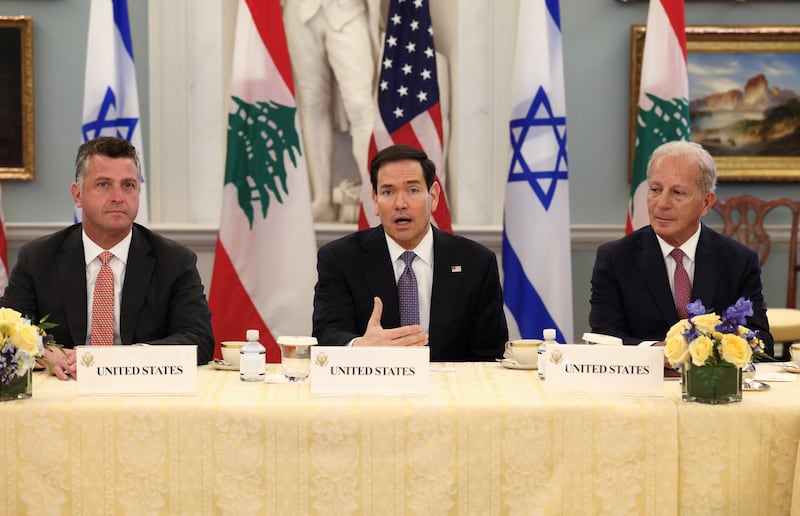
“This is a historic opportunity,” Rubio said before the meeting began. But he was also realistic, adding that “we understand we’re working against decades of history.”
Trump, meanwhile, insists that Iran had reached out to the United States about another round of negotiations. However, he declined to say whether the U.S. has agreed.
“We’ve been called by the other side,” he told reporters outside the Oval Office. “They’d like to make a deal very badly.”
Experts argue that for a deal to be reached, both sides would need to make major concessions. As for the endgame?
“Everything is possible because of the oscillating quality of the president,” said Robert Malley, who was as a lead negotiator for the U.S. in the 2015 nuclear deal with Iran.
“Talks could go on as some are suggesting, war may resume, the impasse may persist, President Trump could walk away or there could be military escalation,” said Malley, who was also a special envoy for Iran under President Joe Biden.
“Any of the above is anyone’s guess because it lies in President Trump’s erratic hands.”