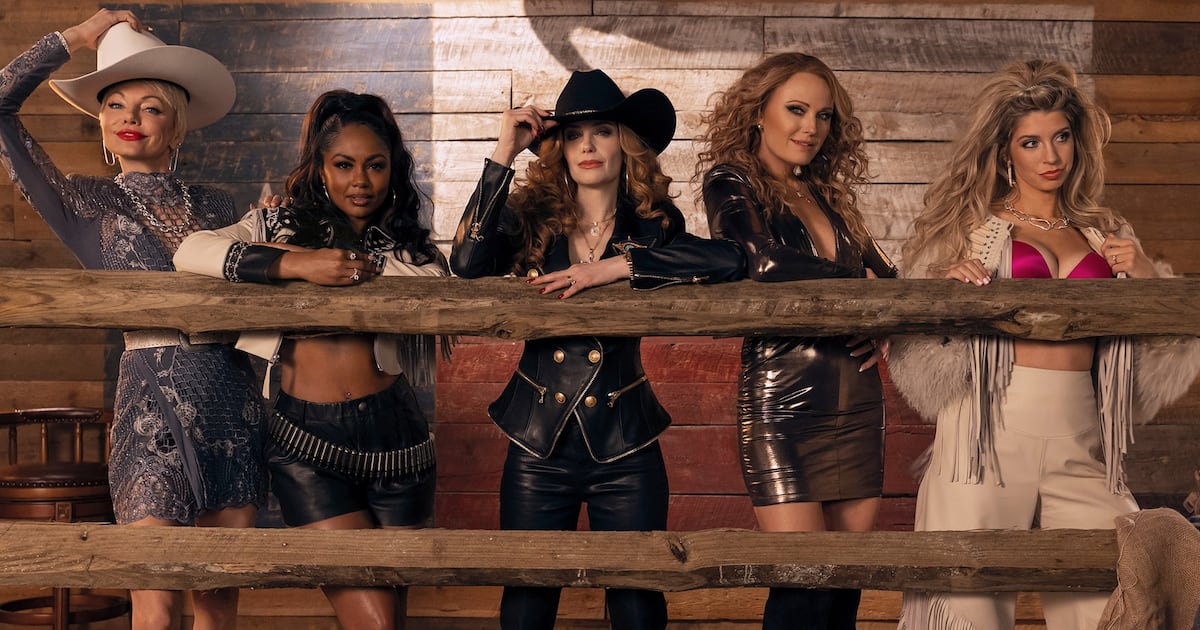
The Hunting Wives’ first season was a boozier, hornier, more homicidal MAGA version of Big Little Lies, and it’s practically a blackout drunk nymphomaniac serial killer in its sophomore outing, piling on steamy lesbian sex, ruthless murder, and blackmail, cover-ups, and betrayals like a show that doesn’t know when to cut itself off.

Based on May Cobb’s book, Rebecca Cutter’s Netflix series (Nov. 26) is a red-state orgy of absurd soap-opera excess, and if that infuses it with go-for-broke verve, it also makes it consistently preposterous and inane. There’s nothing understated or realistic about this ongoing tale of Texas women wrapped up in a ceaseless mess of their own making (complete with intimations of sexual abuse and incest!). But there’s plenty of over-the-top titillation and melodrama—too much, in fact, such that by the time this season concludes, viewers may feel more exhausted than aroused by its non-stop eroticized outrageousness.

In Maple Brook, Texas, Boston-transplant Sophie (Brittany Snow) can’t stop dreaming about locking lips (among other things) with love-of-her-life Margo Banks (Malin Akerman), the wife of gubernatorial candidate Jed Banks (Dermot Mulroney). The problem is, Sophie ran over Margo’s brother Kyle (Michael Aaron Milligan) and dumped his body in a quarry lake at the end of last season, and this secret is eating her alive. It’s complicated by the prior drunk-driving fatality on her record, as well as by Margo’s slaying of teenager Abby (Madison Wolfe), who was mad that her boyfriend Brad (George Ferrier) knocked up Margo, who subsequently had a not-very-Republican abortion.

Margo’s in the clear for offing Abby at the start of The Hunting Wives’ return engagement, having successfully pinned it on Brad’s mother Jill (Katie Lowes), who actually did kill Abby’s mother Starr (Chrissy Metz). Brad is a wreck because of this nightmare, but his life at college takes a turn for the better when—thanks to a viral video of him singing a sad song—music producer Chase (John Stamos) discovers him.
Alas, this entertainment-industry bigwig is merely another bad influence destined to get Brad into intoxicated and bloody trouble, because Cutter’s series zealously believes in miring all its cartoon characters in tawdry situations involving wild carnal couplings followed by reckless shootings and bludgeonings.

Åkerman still wears awful wigs and incessantly bares all as Margo, an intimidating firebrand in and out of the bedroom, and she quickly joins the cast of friend (and former lover) Callie’s (Jaime Ray Newman) The Real Housewives-esque reality TV show “Married Justice.” That program’s producer Nadia (Kim Matula) is, wouldn’t you know it, a divorced lesbian, and every other character from season one who didn’t have a romantic subplot receives one during the course of these eight episodes, including deputy Wanda (Karen Rodriguez), who’s convinced—to the annoyance of her boss (and Callie’s husband) Sheriff Jonny (Branton Box)—that the discovery of a blue pick-up truck in the middle of a remote road indicates that another crime has taken place.
It has, of course—this is Kyle’s vehicle. However, The Hunting Wives distracts Wanda with an investigation into the murder of 16-year-old Elly, who’s found buried in the woods. This latest corpse is related to the arrival in Maple Brook of biker gang leader Zelda (Dale Dickey), who thinks that Kyle did the dirty deed and wants revenge. When she can’t find the (deceased) scumbag, she comes looking for Margo, further upending her life and Sophie’s chaotic day-to-day as she goes to couples therapy with her grating estranged husband, Graham (Evan Jonigkeit), even as she continues indulging her uninhibited, Margo-centric impulses.

The Hunting Wives is loud and proud about being ridiculous trash, with Margo and Sophie constantly stripping down and falling into each other’s arms, and everyone else likewise responding to crises by surrendering to their libidinous urges. While Margo’s clandestine abortion and Jed’s political campaign—which is now run by Lincoln Trout (Alex Fitzalan), a cutthroat manager who’ll do anything to get his client into the governor’s mansion and, later, the White House—are both key components of Cutter’s tale, the series goes lighter on the MAGA-friendly elements in Season 2. Instead, its main focus is capital-letters SEX and MURDER, with every episode entangling its players in clownishly overcooked sensual relationships and violent circumstances.
Every 15 minutes, The Hunting Wives inspires viewers to laugh at—rather than with—its hot-to-trot action, and that appears to be intentional; Cutter is after dumb, dialed-to-eleven sensationalism. Her stars give her precisely what she wants, delivering performances of maximum histrionic boldness. It’s a cavalcade of overdoing it, and Akerman leads the charge as horny Texas badass Margo, who can’t keep herself out of lethal peril. Snow, unfortunately, isn’t as comfortable in these outlandish proceedings, her frenzied reactions and tough talk coming off as affected. By the end of this chapter, Sophie is decidedly unsympathetic—a big problem, given that, no matter the protagonist’s misdeeds, Cutter intends for audiences to be on her side.
Epitomized by Mulroney’s hammy turn as pitiless striver Jed—a caricature of a caricature—The Hunting Wives leaves no moment untouched by silliness, and though that gives it a looney vitality, it also makes it increasingly wearisome. There’s only so much campiness a show can take, and this season, its template is so firmly established that it’s easy to foresee each forthcoming goofy twist. Perpetually operating at a ludicrous fever pitch, it falls victim to its own immoderation, with its climactic bombshells—which arrive on the heels of numerous preceding disasters and revelations—resonating as inevitable and sluggish.
It’s somewhat surprising that, in Season 2, The Hunting Wives’ conservative milieu (and politics) is largely an afterthought, since that’s precisely what set it apart from its female-targeted TV competitors. Leaning heavier into crude sleaziness will undoubtedly earn it the attention it craves, and it prevents it from ever being outright boring.
For all its headline-courting craziness, however, it’s yet another case study of more being considerably less.