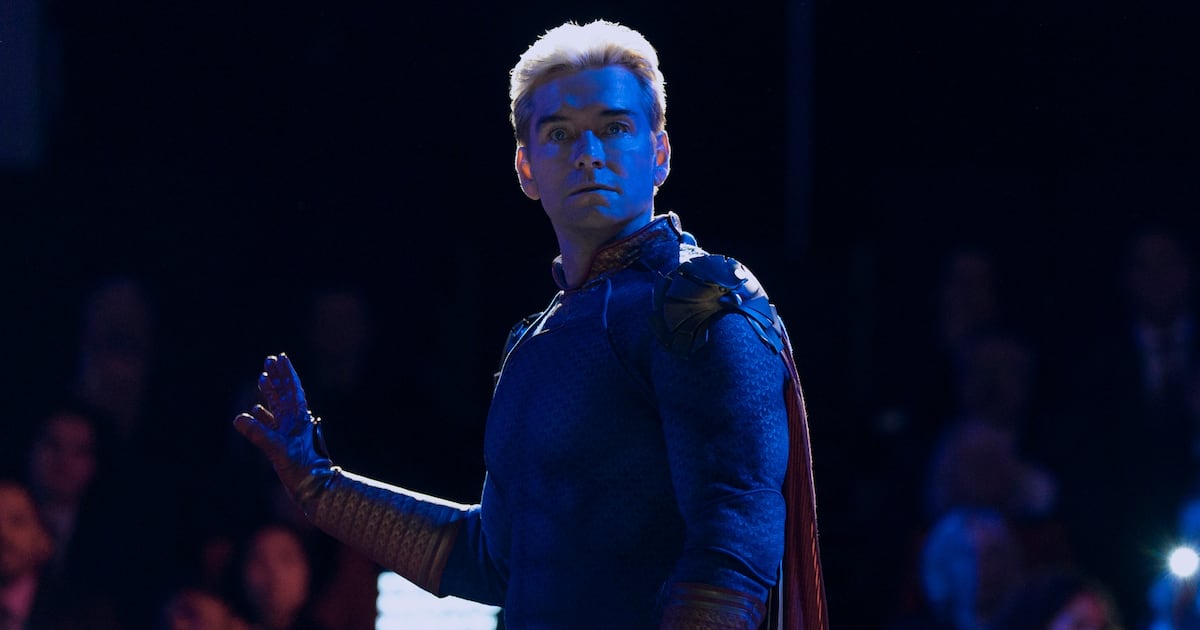
The popular superhero satire The Boys has always focused on skewering MAGA-inspired villainy, most pointedly through the character of Homelander (Antony Starr), an all-American psychotic with the powers of Superman and more screwy hang-ups—he’s a fragile mama’s boy who loves breast milk, craves adoration, and hates humanity—than can be found in an arena full of right-wing loons.
The Prime Video series’ swan song final season pushes its wacko censure to the extreme, complete with its megalomaniacal Trumpian baddie going literally God-tier insane.
For its fifth and final season, Eric Kripke’s adaptation of Garth Ennis’ comics (Apr. 8) takes as its apparent inspiration those bonkers memes in which Jesus hovers over our current president of the United States, even as it has Homelander repeatedly fume over the nasty viral memes that continue to hurt his boundless ego. A cartoonish rebel yell against homegrown conservative fascism that locates and lampoons the religious underpinnings of chosen-one tyranny—all while slicing and dicing liberals via a steady stream of jabs—The Boys soars wildly to the finish line, its confidence only matched by its craziness.
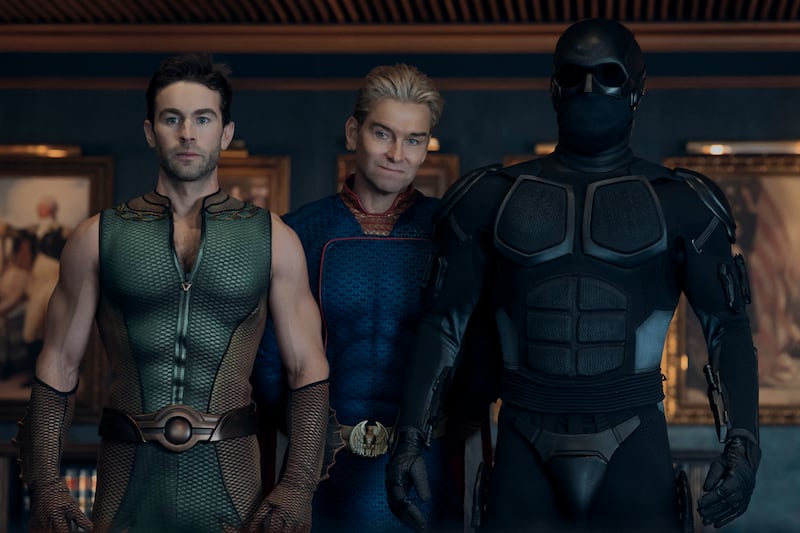
Because Prime Video has yet to provide critics with the series finale, it’s impossible to say whether Kripke successfully sticks the landing of his streaming hit. Still, the first seven installments of this eight-episode home stretch are assuredly off-the-wall, beginning with Homelander.
The blonde-haired, blue-eyed maniac can’t grasp that his lack of wholesale popularity has something to do with the fact that he’s become an outright fascist, creating work camps where he imprisons “terrorist” dissidents and controlling the president of the United States Calhoun (David Andrews) and his Vice President Ashley (Colby Minifie), who’s newly married to fair-weather preacher Oh Father (Daveed Diggs), and whose prior dabbling in Compound-V—the chemical which Vought Corporation uses to create superhumans—has left her with a surprising ability.
Homelander is at war with “Starlighters,” the rebel supporters of Starlight (Erin Moriarty), although, according to anti-communist tradition, anyone who disagrees with his authoritarian policies gets slapped with that label.
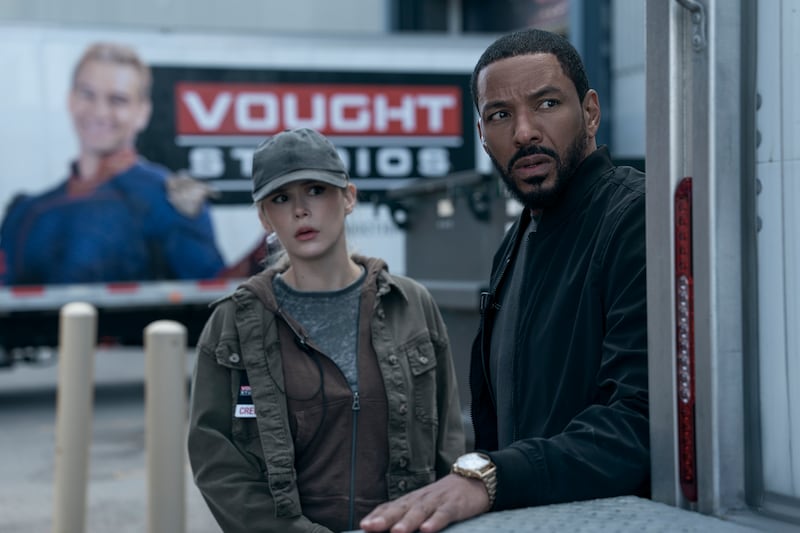
He’s a staunch advocate of compliance by terror, and when footage of a Season 1 misdeed is leaked to the public, Homelander and his cohorts in The Seven decry it as an AI deepfake. Moreover, the Stars and Stripes-caped sadist hatches a plan to execute the titular Boys—Hughie (Jack Quaid), Mother’s Milk (Laz Alonso), and Frenchie (Tomer Capone)—in order to draw out his true nemeses, Starlight and Billy Butcher (Karl Urban), whom he knows are behind this latest humiliation and who stand in his way of world domination.
As is its trademark, The Boys hits as many hot-button topics as possible, from media disinformation, coups, deportations, DEI, vaccinations, and pandemics to billionaire nefariousness (Peter Thiel gets an early shout-out), government stormtrooper squads, and the online manosphere, where sycophantic The Deep (Chace Crawford) now resides courtesy of a podcast he co-hosts with mute assassin Black Noir (Nathan Mitchell).
Modern materialism, consumerism, and pop culture (in particular, Taylor Sheridan) also take a beating. Never preachy, it’s a superhero saga that remains a cracked-mirror reflection of our present moment, scorns the right, and humorously mocks the left. All the while, its instincts stay sharp as it unfurls its cataclysmic narrative.
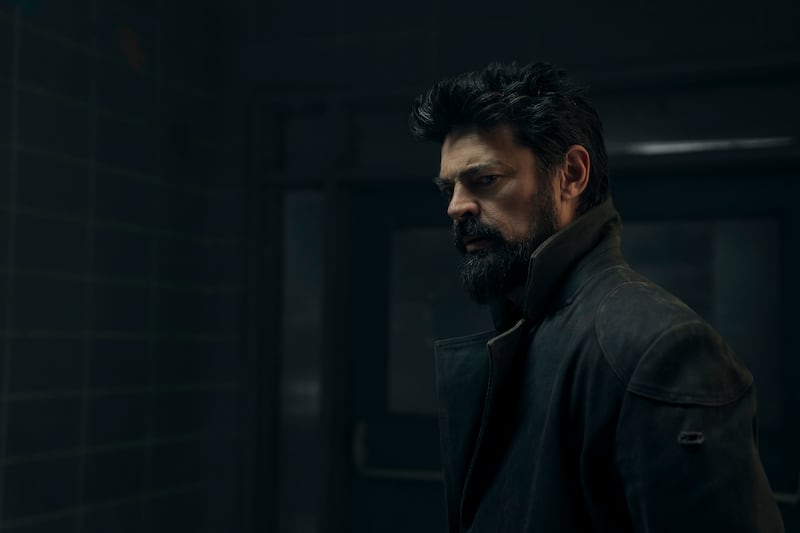
Billy and his ragtag compatriots are, at season’s outset, determined to forever thwart the supe (and Homelander) menace by unleashing a virus that will wipe them off the face of the Earth. This poses not-inconsiderable problems for Starlight and Kimiko (Karen Fukuhara), the enhanced members of The Boys, and it becomes more complicated when it turns out that their genetically engineered plague doesn’t work on anyone injected with V1, the original Compound-V formula.
Thus, a race commences to find any existing vials of this magic elixir, with Homelander viewing it as his ticket to immortality—and thus godhood—and Billy recognizing it as the one obstacle to finally ridding the world of supes, no matter that he now counts himself among them.
Homelander’s desire for deification is the driving force of The Boys’ last lap, if merely one of its many plot threads, as this sprawling tale involves an enormous roster of noble and devious characters torn between doing the right thing and protecting their own hides.
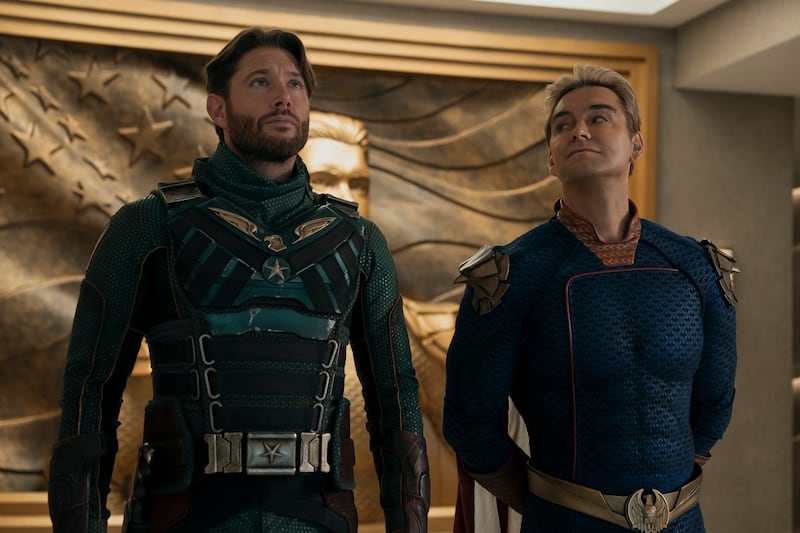
Whether it’s Starlight and Hughie’s strained relationship, Kimiko’s newfound ability to speak, Firecracker’s (Valorie Curry) interest in staying in the good graces of Homelander, or Homelander’s mixed-up feelings about Soldier Boy (Jensen Ackles)—his cryogenically frozen father—the series is awash in storylines.
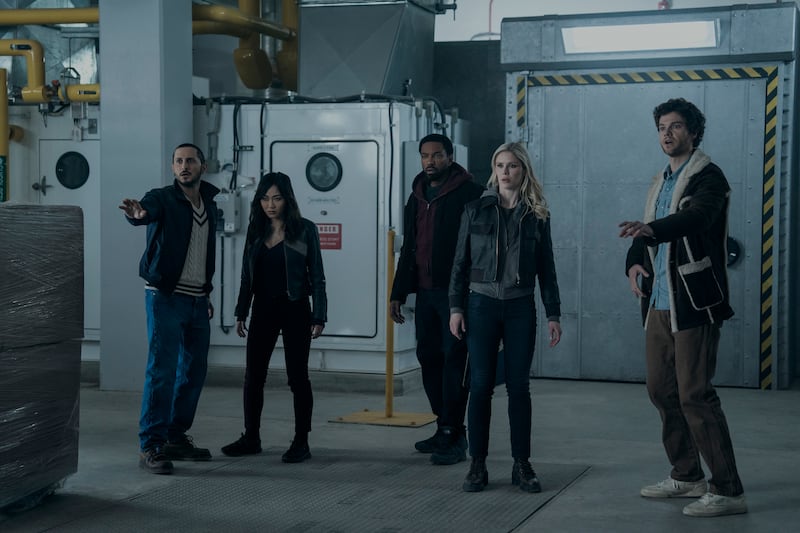
Fortunately, Kripke gives each of them considerable attention as he simultaneously thrusts everyone toward a finale destined to end with an apocalyptic-grade showdown.
There are fights aplenty in The Boys, as well as cameos from familiar faces (including from Gen-V) and a few surprising celebrities, contributing to the material’s tongue-in-cheek spirit. Additionally, the action is rocked by a handful of momentous deaths, which heightens the sense that there are real stakes at play.
Only in its second half does the show get a bit off track, thanks to everyone trying to find a supe who’s the definition of underwhelming (and is introduced just so he can factor into the forthcoming prequel series Vought Rising). However, the cast’s performances are as assured and amusing as ever, led by Urban as the profanity-spewing rogue Billy, and Starr, evoking a bottomless well of twisted neuroses as the unhinged Homelander.
Coursing throughout The Boys’ juiced-up veins are relevant questions about the best means of fighting despotism, the limits of ruling by fear, and the sustainability of democracy in the face of various 21st-century threats.
All of those issues, however, are in service of a warped battle between good and evil carried out by men and women who, for the most part, are as well-defined as the Marvel and DC icons upon whom they’re nominally based. Throughout the course of The Boys’ run, Kripke has made us care about these heroes and villains, and that doesn’t change as some of them die, others triumph, and Billy and Homelander head toward an inevitable face-off.
The Boys doesn’t stop imagining superheroes as decidedly demented and gross in its farewell, but to its credit, it moderates its comic hijinks in favor of resolving its myriad players’ dilemmas and conflicts. How it all shakes out is, at this point, anyone’s guess. Not in doubt is that, barring a stunning last-second collapse, Kripke has, with his small-screen gem, given superheroes the no-holds-barred send-up they deserve.