

It’s been seven years since Hélène Cattet and Bruno Forzani overwhelmed the senses with the dazzling Let the Corpses Tan. Their long-awaited return engagement Reflection in a Dead Diamond, on Shudder Dec. 5, doesn’t disappoint, hurtling viewers through a kaleidoscopic vortex of cinematic sights and sounds in order to celebrate, critique, and have delirious fun with their chosen genre.
In this case, that would be Swinging Sixties James Bond-ian spy adventures, whose dashing heroes, nefarious villains, alluring beauties, and stylish sex and violence are all remixed by the married French auteurs into a dizzying down-the-rabbit-hole fantasia. Strap in, hold on, and succumb to this ecstatically inventive one-of-a-kind film.
As with their prior work (Amer, The Strange Colour of Your Body’s Tears), Reflection in a Dead Diamond is a hallucinatory swirl of conventions, devices, motifs, and musical cues, all of them reconstructed as a self-conscious movie maze.
Their story, if it can be called that, begins with John Diman (Fabio Testi), a dapper older gentleman with a gray goatee that matches his white suit and wide-brimmed hat. John sits on a Côte d’Azur beach smoking a cigar, sipping a martini, and watching a young woman in a red bikini who, upon removing her top, reveals a nipple that glistens in the sun like a diamond.
At the same time, Cattet and Forzani segue to a shirtless stud (Yannick Renier) at the controls of a yacht, who’s told over the radio—as a paramour with red fingernails seductively pulls off his shoulder holster—that thanks to him, they’ve recovered the uranium and dismantled the organization. This secret agent, it turns out, is the younger John, and after dipping his hand in a tray of diamonds, he and the woman embrace. Following their (off-screen) tryst, he enjoys a cigarette and she lifts her head from the pillow, sparkling diamonds embedded in her cheek.

This is merely an initial taste of Reflection in a Dead Diamond’s madness. The older John is told by a hotel manager that his bill is due, but he’s more concerned with the woman in the room next door, who’s gone missing. He spies a red convertible drive away, at which point the film transitions to a theater where an opera is being performed, and then to a wacko 007-ish credit sequence in which young John, in glowing silhouette, shoots diamonds from a pistol and stabs a female assailant with the Eiffel Tower.

The action is tethered by images and sound—such as a shot of glistening ocean water morphing into the sizzling tip of a cigarette—and Cattet and Forzani make no concessions to lucidity, barreling forward with whiplash speed and intensity, assuming their raft of signifiers and snippets of dialogue will hold the material together.
They’re correct, as Reflection in a Dead Diamond is at once completely intelligible and totally opaque—a contradiction that makes sense once one accepts that the point is less straightforward plotting than rapturous pastiche.
The elder John opens a case full of gadgets as a voice explains that his car is outfitted with .50 caliber machine guns in its headlights, his cigar case is a pistol scope, his watch is a remote detonator, and the laser in his ring lets him see through walls. John has a license to kill and the swashbuckling good looks to woo any woman who enters his orbit.

The next assignment he receives from his boss is to protect oil tycoon Markus Strand (Koen De Bouw). That mission seems basic, but it becomes thorny when Markus slays John’s female accomplice (Céline Camara), whose disco dress is made up of myriad reflective discs that function as both weapons and video recorders. Camara’s get-up also serves as a recurring motif that speaks to the film’s fascination with the links between beauty and violence, bliss and suffering, and John’s acquisition of two of its discs reveals Markus to be a deadly foe.
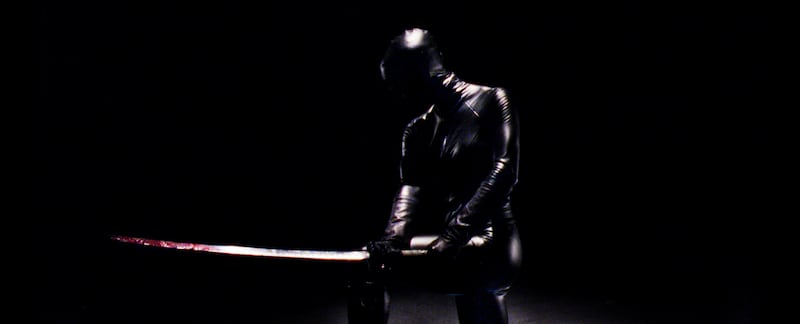
John’s eventual focus, however, is a lovely and lethal assassin known as Serpentik, who assassinates her targets in a full-body latex suit and with sharp red metal fingernails and a spiked boot heel. On her tail, John comes upon pieces of a person’s face, and before long, he learns that she’s a master of disguise, to the point that even with her mask off, her identity remains a mystery.

As the older John is surveilled by an enigmatic stranger (Maria de Medeiros), his younger self hunts Serpentik as well as a variety of secondary adversaries—such as a fiend named Kinetik who hypnotizes victims to believe that they’re in movies, killing them when they see “The End”—which further casts the proceedings as the demented reverie of a Bond obsessive.
Reflection in a Dead Diamond is self-conscious from the start, and it underscores its artificiality in late passages that halt the story so cameras can reset, makeup can be reapplied, and sets can be dressed. Everything is at once real and unreal in Cattet and Forzani’s latest, and their mise-en-scène is so daring and dexterous—on numerous occasions, their brilliant match cuts elicit an excited gasp—that the film proves a giddy tribute to big-screen espionage odysseys. By stripping the genre down to its base elements and dialing things to 11, particularly in terms of stylized viciousness, they simultaneously expose the fundamental surface-over-substance nature of their inspirations, whose narratives are forgettable vehicles for widescreen panoramas of swoon-worthy seaside locations, striking automobiles, and elaborate action-packed set pieces executed by attractive stars.

The past and present collide in Reflection in a Dead Diamond. The tale is a sexualized blend of vengeance, treachery, murder, glamour, wealth, and brutality that’s decked out in designer threads and embellished with pointed accoutrements (rings, blades, swords) and a cornucopia of mirrors, alarms, flashbulbs, blood, and poison.
“My dream was chaos,” says Serpentik, ably summing up the film. Cattet and Forzani’s frame is always imaginatively twisting, turning, rotating, and mutating, such that their formal artistry becomes not just the main attraction, but the entire point of this crackling, moaning, roaring, shrieking endeavor. It’s easy to get lost in the writer/director’s swirling spy game—and, also, thrilling, so long as one is willing to set aside demands for convention and embrace the insanity of this euphoric work of pure cinema.