Cinema is tailor-made for grandness—of scope, of scale, of stakes, of spectacle, and of emotion—and Project Hail Mary embraces that strength with a masterfulness that’s all too rare in today’s modern multiplex landscape.
Adapted from Andy Weir’s novel of the same name, Phil Lord and Christopher Miller’s IMAX-sized film is science fiction that, like Weir’s prior The Martian, emphasizes science, even as it races to the far reaches of the galaxy, where baffling mysteries and unexpected entities reside. With a first-rate Ryan Gosling at the helm of this interstellar odyssey, it’s a stirring celebration of bravery, camaraderie, and human ingenuity that goes big in every respect, not least of which by recognizing and foregrounding the majesty of larger-than-life movie stardom.
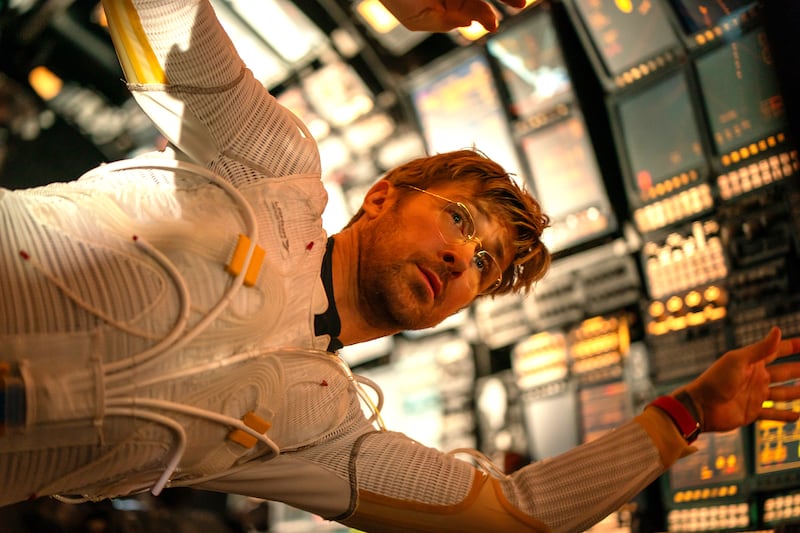
Gosling’s magnetism fuels Project Hail Mary (March 20, in theaters), with Lord and Miller placing their headliner front and center throughout this journey to the cosmos, whose start is an inauspicious one, with Dr. Ryland Grace (Gosling) awakening from a medically induced coma aboard a spaceship. With long hair and an overgrown beard, Grace has clearly been out of commission for an extended stretch. His initial confusion is almost as severe as his body is weak and unstable, giving Gosling the opportunity to exhibit the slapstick-y physical comedy prowess he first demonstrated to hilarious effect in The Nice Guys.
As he swings and stumbles about his environment, Grace discovers that his two fellow crew members are dead and that he’s a very long way from home. To say he’s not happy about it is an understatement, and as he attempts to regain his bearings and memory, Project Hail Mary begins the intermittent flashbacks that will, over the course of its ensuing two-and-a-half hours, afford context for his mission.
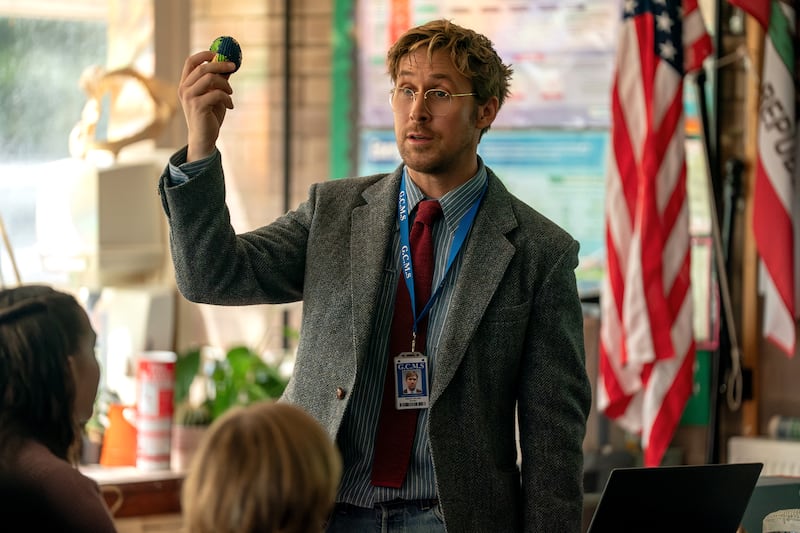
Those commence in a middle school classroom where Grace, a teacher, is questioned by students about the “Petrova Line,” a perplexing stretch of light between Venus and the Sun that appears to be dimming the latter to potentially catastrophic ends.
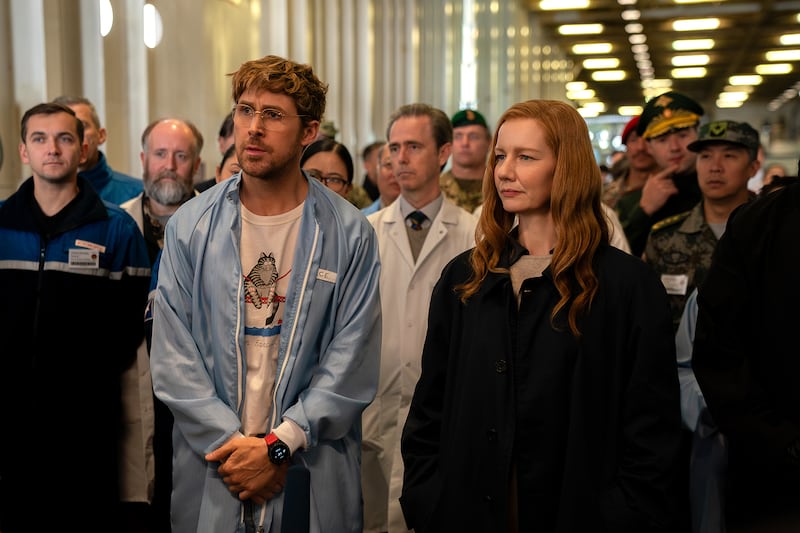
As it turns out, there’s no “potentially” about it. Grace, whose career as a molecular biologist was cut short by a controversial theory about extraterrestrial life, is visited by Eva Stratt (Sandra Hüller), who has him investigate a sample of the Petrova Line’s “astrophage” material.
With every new development, Project Hail Mary leans into scientific nitty-gritty without losing sight of its main character or his primary objectives and conclusions, and after much clumsy research, Grace deduces that astrophage is a single-cell organism that’s consuming the Sun’s energy and, in thirty years’ time, will spell Earth’s doom. Worse, this isn’t simply our problem, since these hungry aliens are also devouring every star in sight.
Except, however, that there’s one distant sun that’s somehow immune to the astrophage’s appetite, and Stratt—working with the world’s governments—plans to send a ship to find out what makes it so special. To reach such a destination requires near light-speed travel, and thanks to Grace figuring out how the explosively powerful astrophage multiplies, a plan is hatched to use it to power a craft in a last-ditch “Hail Mary” venture—the catch being that those who embark on this assignment won’t be coming back.

Project Hail Mary is equal parts The Martian and Interstellar, albeit with Lord and Miller’s sense of humor, which shines through every stage of the voyage. For Grace, manning a high-tech vessel is far above his pay grade, and yet, as he repeatedly proves, his resourcefulness is his greatest tool. For a tale about visiting alien planets and solving apocalyptic crises, the film is decidedly grounded, always maintaining strict focus on human creativity and adaptability as the keys to piecing together the most daunting of puzzles.
Especially in this day and age of people relying on A.I. to handle every rudimentary task, Project Hail Mary’s portrait of quick-witted and imaginative problem-solving is bracing, and so too is Gosling’s performance. Seemingly in over his head at the outset of his herculean task, Grace struggles to keep himself on track, and the actor’s self-deprecating charm and determination make the protagonist an unlikely crusader for whom it’s easy to root.
Moreover, he’s just as good once he winds up less alone than he initially expected—a twist that won’t be spoiled here, but which gives him an opportunity to wittily play off a unique foil whose outlook on life, and their undertaking, is a catalyst for transformation.
While Hüller is amusing as the no-nonsense Stratt and Ken Leung, Lionel Boyce, and Milana Vayntrub are sturdy in supporting parts, Project Hail Mary is principally a one-man show, even once it becomes an endearingly wacko buddy comedy.
Step by step, its story has Grace confronting and cracking unanticipated and eccentric dilemmas, and in its latter half, it additionally evolves into a fable about the nature of heroism. For Grace, finding a reason to sacrifice himself entails growing close to another, and in that regard, the film is ultimately about how friendship and togetherness are the driving forces behind our best impulses.
Lord and Miller paint on a gigantic canvas; their dazzling panoramas occasionally channel a bit of 2001: A Space Odyssey’s wonder and terror, and their centerpieces are clever and nerve-wracking. Project Hail Mary has been crafted for the hugest of screens, and that dimensionality is in keeping with its outsized bid for poignancy, particularly during its home stretch.
Given that its final third features multiple possible endings, the directors’ more-is-better approach can be a minor hindrance. Still, their enormous ambition largely produces tremendous results, aided by Gosling in a turn that expertly mixes daring, doubt, and just the right amount of everyman goofiness.
With its coda, Project Hail Mary flirts with cutesiness, but Lord and Miller have by that point earned more than enough goodwill to make it go down smoothly. As heartfelt and wondrous as their prior works were hilarious (21 Jump Street, The Lego Movie) and exciting (Spider-Man: Across the Spider-Verse), it’s a sign that the directors are continuing to evolve into a formidable Hollywood pair—and suggests, thrillingly, that they’re cut out for even bigger things.