Given the groundbreaking tools at their disposal, modern filmmakers are only limited by their imaginations. Boots Riley isn’t lacking in that department, and yet, as evidenced by I Love Boosters, he has little idea how to harness his various ideas, his latest a smorgasbord of hastily sketched cultural and political ideas that would barely elicit engagement on TikTok. Simplistic, scattershot, and—worst of all—unfunny, it’s a social commentary-laced crime comedy of insufferable proportions.
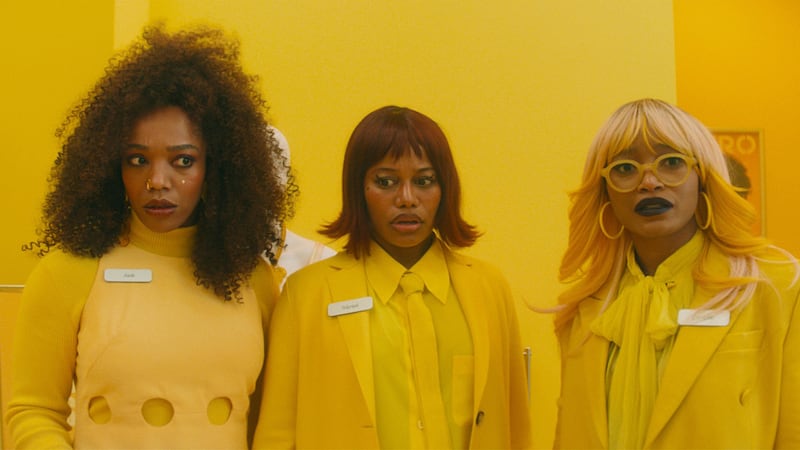
I Love Boosters (May 22, in theaters) is in line with the auteur’s prior Sorry to Bother You and I’m A Virgo, insofar as it’s a candy-colored hodgepodge whose every gag seems designed to make viewers wince with embarrassment. In a hyper-exaggerated Oakland, Corvette (Keke Palmer) steals clothes and then resells them for a fraction of the cost to the masses who wouldn’t otherwise be able to afford them. This makes her a “booster,” and she carries out her Robin Hood-ish endeavor with her best friends Sade (Naomi Ackie) and Mariah (Taylour Paige). Like Corvette, they wear outlandishly stylized outfits that take ostensible inspiration from everything and anything, including anime, Jackie Onassis, Midsommar, blaxploitation, and—with one bosom-heavy get-up—furries.
Riley’s mile-a-minute script isn’t interested in delineating its central trio, such that even Corvette’s foundational dream of being a fashion designer is only conveyed by a snippet of rapid-fire dialogue. At least she has that personality trait; Sade and Mariah are just brash cohorts along for the ride, with the writer/director treating them as pawns in an elaborate game of make-believe whose purpose seems to be to grate on every last nerve. All three strike memorable visual poses, but they can’t do anything with material that doesn’t sincerely care about their characters except as vehicles for Riley’s pedestrian preaching.
Corvette’s big beef is with Christie Smith (Demi Moore), an egomaniacal fashion titan who prattles on about how “humanity is our canvas” and who loathes Corvette, Sade, and Mariah (randomly referred to, at one point, as “the Velvet gang”) for pilfering her upscale threads. Denigrating the thieves as “low-class urban b---hes,” Christie is coded as a racist along with being the embodiment of big-business exploitation, and Moore plays her with a profanity-laced gusto that’s shocking in its humorlessness. Sporting blonde hair, giant glasses, and oversized suits, her villain is a caricature of a caricature, and her cocky weirdness is epitomized by the fact that she lives in a leaning skyscraper that makes everyone struggle to stay upright.
This is not amusing, and neither is any other I Love Boosters flourish, be it Corvette running in place (with whirlwind feet) à la the Road Runner, subplots about pyramid schemes and TV talking heads, sequences shot with split screens and in slow motion, and climactic stop-motion effects. It’s maximalism run amok, and Riley never lets up, piling on the cartoony characters, incidents, and out-of-this-world elements. Seldom does a film work this hard to achieve so little, with Natasha Braier’s cinematography as deliberately Skittles-grade garish as Tune-Yards’ eclectic score—complete with off-key carnivalesque horns—is insistent and shrill.
Corvette, Sade, and Mariah use various distractions to pull off their heists, stuffing their snatched goods in their shirts and pants so that, in one parking lot shot, Palmer’s protagonist faintly resembles the Stay Puft Marshmallow Man. To further their aim, they take a job at a posh retailer where they meet wannabe-unionizer Violeta (Eiza González) and Jianhu (Poppy Liu), the latter a Chinese factory worker who appears out of nowhere to clean out the store with a “magic bag.” As they soon learn, Jianhu is actually in possession of a teleporter that transfers items back to her native China. If this isn’t silly enough, the gadget is also a “situational accelerator” that can amplify a target’s inherent nature and a “deconstruction” weapon which has the power to break things down to their building blocks.
This doohickey looks like a toilet seat, which is fitting considering that, as a narrative and comedic device, it stinks. That’s additionally true of LaKeith Stanfield’s “Pinky Ring Guy,” whose every word mesmerizes Corvette but who has a reputation for sucking women’s souls out of their private parts during oral sex. Though Stanfield’s appearances are the film’s highlights, they’re too brief to be more than asides, as Riley can’t keep focus on anything for longer than five seconds. I Love Boosters is ADHD cinema in its purest form, a manic lark that envisions everything in dim Looney Tunes terms, racing this way and that in vain search of a point.

There is, admittedly, a purpose to Riley’s madness: criticizing capitalism as a system that manipulates, abuses, and breeds resentment and loneliness. Thanks to Jianhu’s plight, Corvette, Sade, and Mariah transform into proletariat champions, determined to overthrow the status quo in the name of workers’ rights solidarity. That they ultimately refer to Jianhu’s native China as the “motherland” is a neon-red indicator about the proceedings’ politics. However, the writer/director is too busy throwing haphazard concepts and designs against the wall to craft an intelligible argument, and the helter-skelter finale—full of rainbow catwalks, skinless baddies, and numerous leaps through the teleporter—is simultaneously action-packed and torpid.
I Love Boosters validates Corvette and company’s illicit behavior by contending that everyone steals (including bigwig Christie), and that the new is always born from putting a unique spin on the old. A generous reading of this debacle might maintain that Riley himself has made something fresh by synthesizing various pre-existing cinematic ingredients. The problem is that what he’s concocted is crude and sloppy, slapped together with plentiful verve and scant dexterity. Energetic and vibrant as well as messy to the point of incoherence, it’s akin to a child’s finger-painting portrait of Che Guevara.
Riley concludes this affair with a rah-rah vision of the disenfranchised uniting for a common cause, all as he strains for uplift via Corvette seizing her agency alongside her BFFs. Unfortunately, it’s just one last bit of posturing for a film that’s immensely pleased with itself despite providing no evidence to justify such self-regard. Striving for eat-the-rich timeliness, it proves simply a tedious waste of moviegoing time.