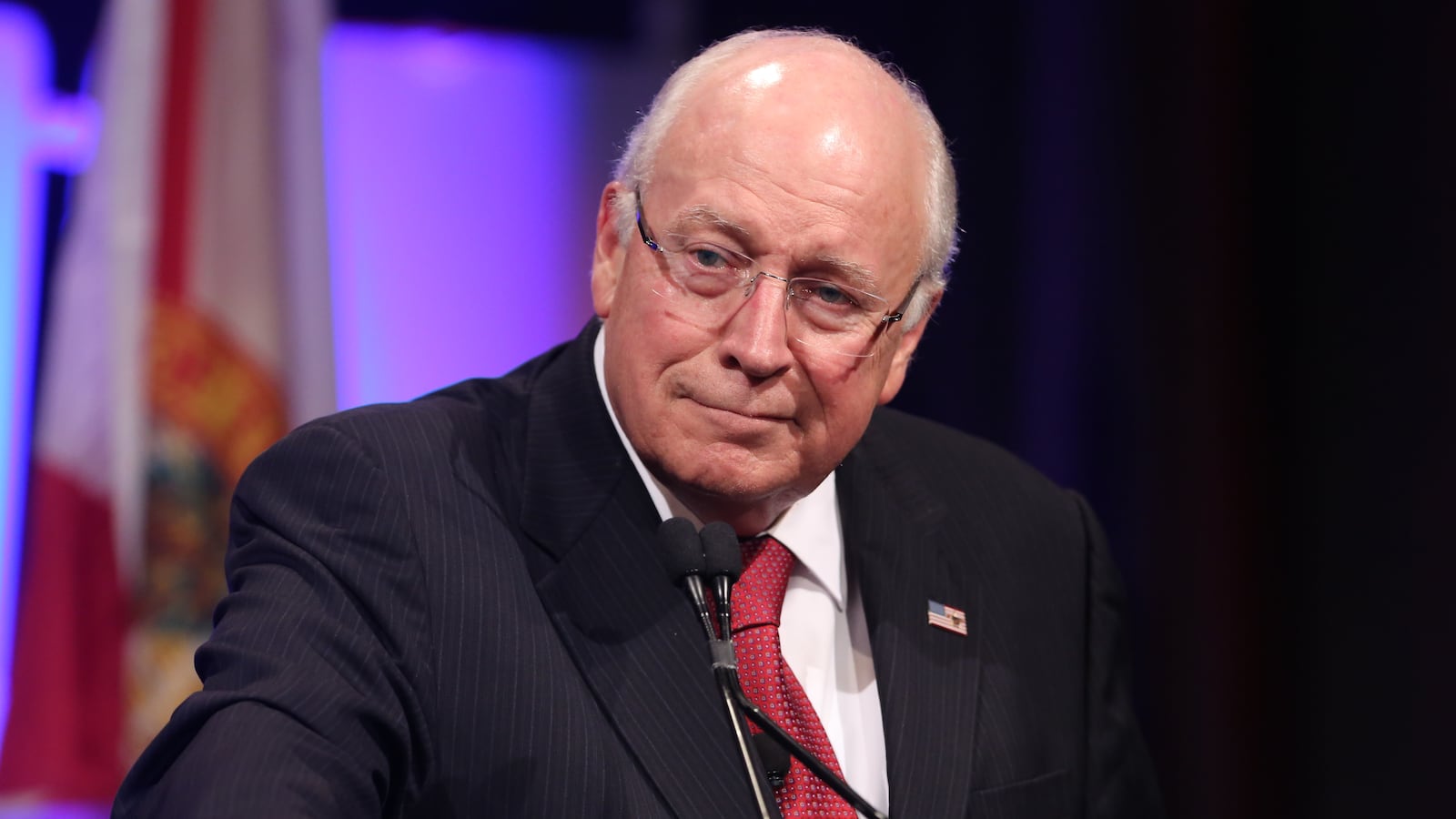
Dick Cheney, the former vice president who was instrumental in pushing the United States into the disastrous Iraq War, has died. He was 84.
Cheney’s family said in a statement that his death Monday was caused by complications of pneumonia and cardiac and vascular disease, according to the New York Times. Cheney, who served alongside George W. Bush from 2001 to 2009, remained a staunch conservative in his final years but said he would not vote for Donald Trump in the 2024 election and heavily criticized the Republican as a threat to the American republic.

In 2024, the Republican stalwart followed his daughter, former Republican Wyoming representative Liz Cheney, in publicly declaring he would vote for Kamala Harris in the presidential election.
“In our nation’s 248-year history, there has never been an individual who is a greater threat to our republic than Donald Trump,” Dick Cheney said at the time. “He tried to steal the last election using lies and violence to keep himself in power after the voters had rejected him. He can never be trusted with power again.”
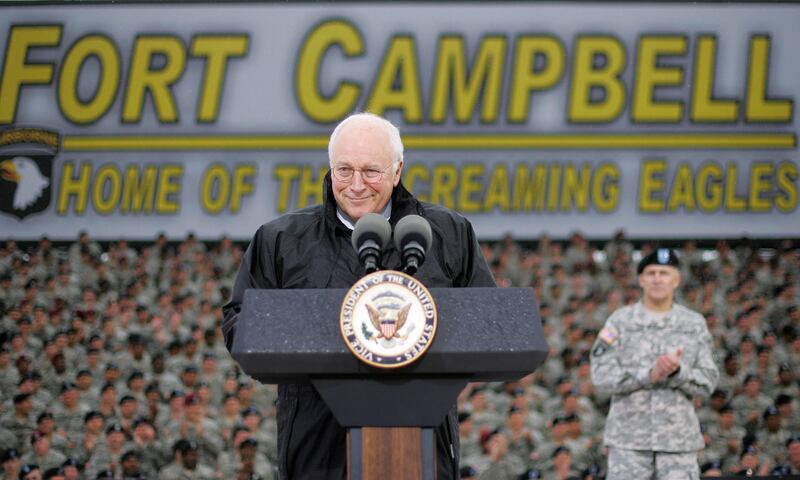
The fissure ousted him from a position of influence within the Republican Party, but he had once been arguably the most powerful man of all. Deputy president, shadow president, co-president—all those terms were applied to Cheney during his tenure in the White House as second-in-command to Bush, an untested and unsure leader who willingly ceded more power than any president before or since to a running mate.
Bush even let Cheney pick himself to join the ticket in 2000 after first appointing him to conduct a search for the ideal running mate. After a thorough examination of several individuals, it became obvious that Cheney had the inside track. His association with Bush’s father, whom he served as Defense Secretary during the first Gulf War, was thought to have sealed the deal.
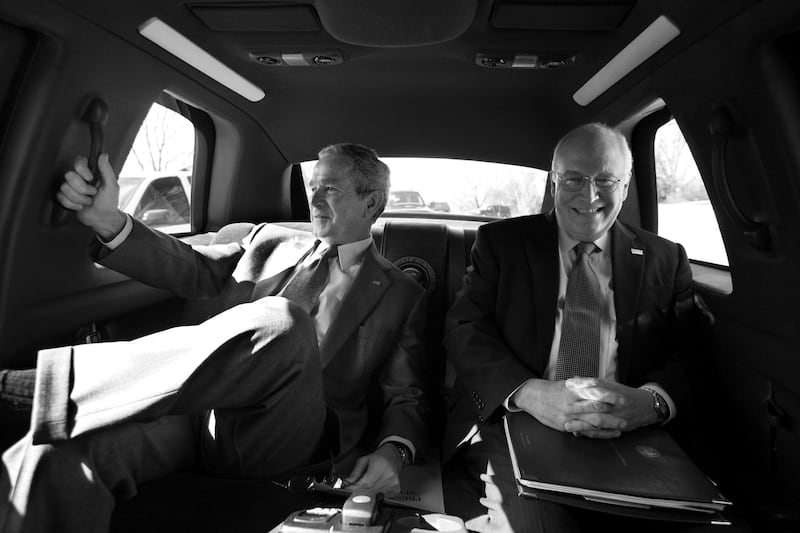
Cheney had to change his residence from Texas to Wyoming to meet the constitutional requirement that the president and vice president aren’t from the same state. The selection process was the stuff of late-night comedic jabs, but the Cheney of 2000 came across as a reassuring figure, the perfect partner to the restless and untried younger Bush.
That would change in Bush’s second term, but by then Cheney had made his mark. His critics called him Darth Vader, an appellation that he readily adopted for himself. It wasn’t for laughs but to send the message to naysayers that he didn’t really care what anybody thought of him.
Richard Bruce Cheney died at an advanced age he never expected to achieve after suffering his first heart attack in 1978, when he was just 37, while he was campaigning for an at-large House seat in Wyoming. He would eventually survive five heart attacks, including one that occurred during the transition after the 2000 election.
Cheney received a heart transplant in March 2012. In their 2013 book, Heart, Cheney and his cardiologist, Dr. Jonathan Reiner, recount the 35 years of medical advances that made Cheney’s long life possible.
Cheney was in his office in the West Wing when the first plane hit the World Trade Center on Sept. 11, 2001. When a second jetliner crashed into the Twin Towers and it was clear this was no accident, the Secret Service literally swept Cheney off his feet to swiftly move him to a bunker under the White House known as the Presidential Operations Center.
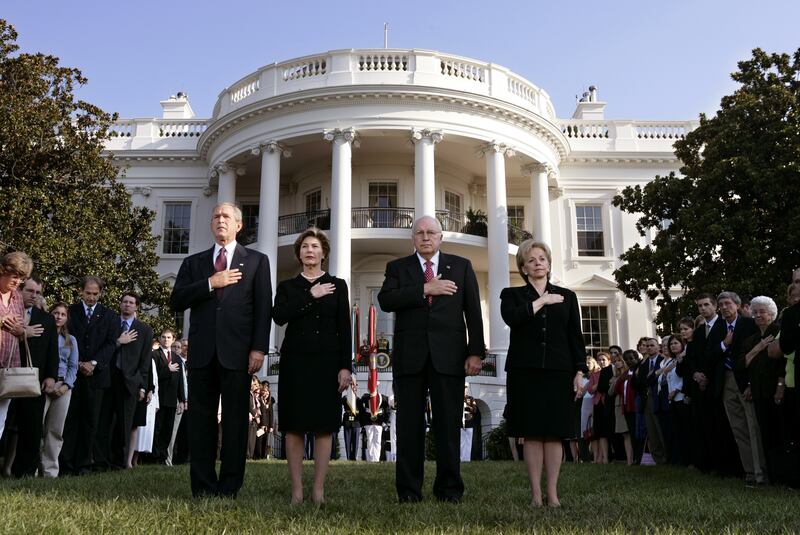
From there, he would communicate with Bush, who was in Florida talking to grade-schoolers about his education reforms. Cheney gave the shootdown order to take down a fourth plane apparently heading toward the White House after a third airliner crashed into the Pentagon.
The fourth plane would be taken down into a field in Shanksville, Pennsylvania by its heroic passengers, sparing Cheney from having to live with the responsibility of shooting it out of the air.
Whether Cheney actually had that authority, or he had usurped it, or Bush had somehow conveyed the order, though there was no record of that, the bond between the two men strengthened as a shaken Bush returned to the White House, grateful for Cheney’s determined calm.
For security reasons, Cheney spent several months in a variety of “undisclosed locations,” later revealed to be a bunker in the vice presidential mansion, Cheney’s Wyoming home, and Camp David.
Cheney and his longtime friend, Donald Rumsfeld, who he’d handpicked as Bush’s Secretary of Defense, would determine how to respond to the most devastating attack on U.S. soil since Pearl Harbor. Afghanistan was the obvious target, but discussion within the White House quickly moved to Iraq and that government’s possible ties to al-Qaeda.
Cheney pressed the CIA for evidence, and in December 2002, just over a year since the 9/11 attacks, CIA Director George Tenet assured Bush in a meeting at the White House that it was a “slam dunk” case that Iraq had weapons of mass destruction.
The war in Iraq that began in March 2003 was predicated on false and fabricated intelligence. It was a war like no other, generating fear among the electorate that gave the Bush administration the license to unleash a barrage of questionably legal and morally objectionable tools.
Beginning in April 2004, the implications of these “enhanced interrogation techniques,” (EITs) shocked the world with the publication of photos from Abu Ghraib prison in Baghdad showing American soldiers torturing and sexually humiliating Iraqi prisoners. Bush professed horror and disgust, claiming he was blindsided. Rumsfeld offered twice to resign over the burgeoning scandal.
In June 2004, a series of memos came to light that would be known as “the torture memos.” Written by Deputy Assistant Attorney General John Yoo, they laid out the dubious legal standing on which the administration’s terrorist surveillance program had been based, along with the justification for such techniques as waterboarding.
For Bush, this was no way to run a re-election campaign. The New York Times reported that he considered replacing Cheney on the ticket as his vice president to distance himself from Abu Ghraib. That would have been a bridge too far for such a long and loyal Bush retainer. Cheney remained on the ticket, and Bush-Cheney won a narrow victory over Democrats John Kerry and John Edwards.
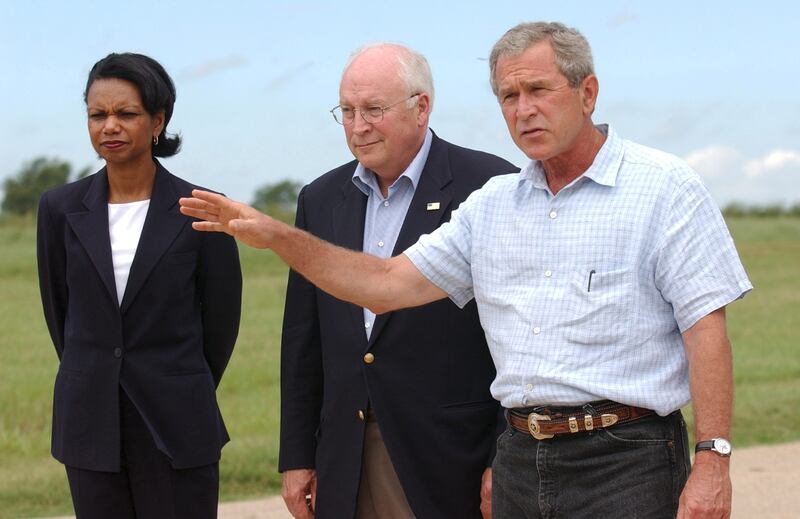
Bush’s second term would be a very different experience for Cheney. The Iraq War was not going well, and Bush faulted Cheney and Rumsfeld. The buddy system that had carried Bush through his first term, and that made Cheney so powerful, had broken down amidst mutual distrust. New York Times White House reporter Peter Baker in his book Days of Fire, about the Bush-Cheney years, cites the vice president’s accidental shooting of a friend in the face on a hunting trip in February 2006 as an indication of the radically altered relationship.
On the advice of longtime adviser Mary Matalin, the Cheney team leaked the story to a Texas newspaper, keeping the White House and the Washington press corps uninformed. The friend, then 78-year-old Richard Whittington, was seriously injured with multiple pellets, some lodged in his larynx and near his right eye, and one near his heart that could not be removed. The daughter of the ranch’s owner said Whittington stepped into Cheney’s line of fire, a comment repeated by White House spokesman Scott McLellan.
Cheney didn’t address the incident publicly for four days. Finally, under pressure from the White House, he did an interview with Fox News offering no apology but taking responsibility: “Ultimately, I am the guy who pulled the trigger.”
The episode transformed Cheney and how he was regarded in the White House and by the media from an all-knowing evil genius to something of a joke. Cheney’s guru-like silence often left White House aides wondering what he was telling Bush in private. “Cheney’s role was like watching iron filings move across a tabletop,” observed Bush speechwriter David Frum. “You know there is a magnet down there. You know the magnet is moving. You never see the magnet.”

The secretiveness that was Cheney’s hallmark looked more like paranoia in Bush’s second term as the war dragged on and the politics worsened. In November 2006, Republicans lost their majority in both the House and the Senate. Bush called it a “thumping.” The next day Rumsfeld was forced to step down as Secretary of Defense. Bush didn’t tell Cheney that he was about to fire his best buddy in the administration. Cheney learned along with everybody else, a signal of his lessened influence.
The American people were tired of war without victory, and Rumsfeld was a deserving scapegoat. He had recommended opening the war with “shock and awe” bombing followed by a small invasion force that would be no match for the insurgency it inspired. Firing him was Bush’s way of starting over. Not telling Cheney ahead of time was the icing on the cake from Bush’s point of view.
As Bush neared the end of his second term, a simmering CIA scandal that involved Cheney aide Scooter Libby came to a head over Bush’s pardon powers. Libby had been convicted of lying to FBI investigators looking into who leaked the name to the media of covert CIA officer Valerie Plame. No one was charged with the leak itself, which was traced to a State Department official, but Libby was sentenced to 30 months in prison and a $250,000 fine.
Bush immediately commuted the sentence, so Libby did not go to jail, but Bush refused to pardon him for the felony conviction. Cheney was furious and sought every possible opportunity to lobby Bush. According to news accounts at the time, Cheney pleaded, begged, and cajoled. He made the case that refusing to pardon Libby was tantamount to leaving a man on the battlefield.
Bush kept his resolve, telling Cheney that he believed Libby was guilty, and that he accepted the jury’s findings. Their relationship would never recover.
Cheney left the White House with a 13 percent approval rating, and he made no overt effort to whitewash his record or the role he played in thrusting the country into two long wars. He has expressed no regret for the heavy-handed security apparatus that he helped put in place, telling Peter Baker in an epilogue to his 2013 book, that it was “the right thing to do. It worked. We haven’t been hit for seven and a half years, longer than that now.”
Cheney’s life came to the big screen in the 2018 movie, Vice, with Christian Bale as Cheney and Amy Adams as his wife and partner in politics, Lynne Cheney.