
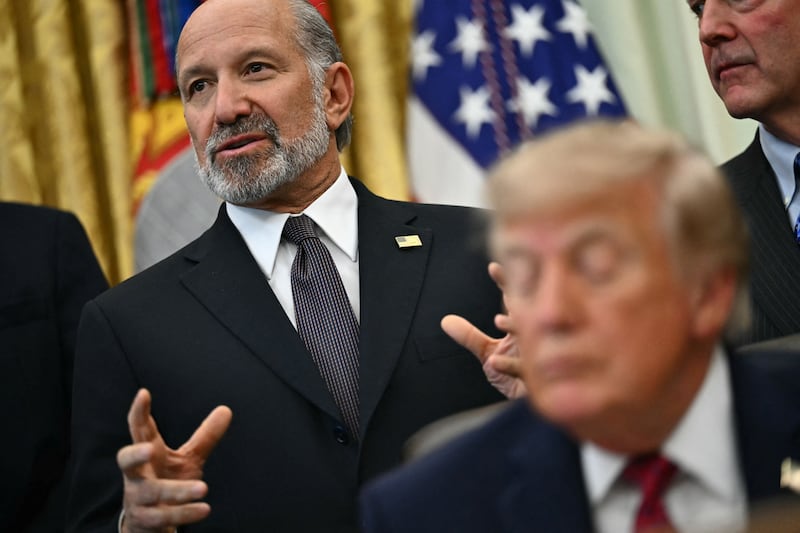
Commerce Secretary Howard Lutnick could be axed in the wake of the sex scandal involving tech billionaire Jensen Huang.
Senior White House officials are reportedly discussing whether Lutnick should be pushed out amid growing concerns that America’s national security is being compromised.

The potential blowback, first reported by Reuters, comes as lawmakers from both sides of the aisle criticized Lutnick over the administration’s refusal to add dozens of Chinese companies to a U.S. trade blacklist, and whether his department was properly overseeing Nvidia’s exports to China.
The latest twist comes after Huang, a key Trump ally, resigned Thursday following revelations of two extramarital affairs—one with a suspected Chinese spy.
Trump revealed this week that FBI was probing the tech billionaire, who had told the president he had “no idea” that the younger woman, Alice Huang (no relation), whom he started socializing with in 2024, allegedly worked for Beijing.
“And I really believe him,” said Trump, who has purchased Nvidia stock in the past and whose administration has made consequential decisions about Nvidia’s ability to sell advanced chips to China.
Jensen Huang’s other alleged affair was with Kimberly Powell, Nvidia’s vice president of healthcare, who reported to him and who is also married.
The New York Times reported on November 11 that five Nvidia employees said it was widely known that Huang and Powell were having an affair.

In his letter before standing down, Huang admitted being unfaithful to his wife, Lori Huang, whom he married in 1985 and with whom he has two children, Madison and Spencer Huang, but didn’t specify who he had cheated on his wife with.
“I owe my family and all of you an apology. I was unfaithful to my wife. My actions hurt her and our children. There is no excuse for what I did. I am deeply sorry,” he wrote.

Trump stood by Huang this week, describing him as a “high-quality person” and “an amazing guy” who was “really suffering” because of the impact on his family.
But he has not explained when he became aware of the national security concerns surrounding Huang or whether sensitive information about Nvidia’s advanced artificial intelligence chips could have been compromised.
The pair have been close allies for months, with Nvidia committing $25 million to Trump’s White House ballroom, and Huang even traveling to China with the president in May for his summit with Chinese president Xi Jinping.
But tensions escalated in the White House in recent days, when Lutnick, according to Axios, was confronted by Treasury Secretary Scott Bessent over the Commerce Department’s failure to impose restrictions on Megaspeed, the Singapore-based company where Alice Huang was an executive.

Secretary of State Marco Rubio reportedly warned Trump about the relationship in May, shortly before Huang joined his trip to China—contradicting Trump’s claim he knew nothing about the allegations.
The White House and the Commerce Department did not immediately respond to a request for comment about Lutnick’s future.
Sources have also said that Lutnick’s deputy, Jeffrey Kessler, the Undersecretary of Commerce for industry and security, could end up taking the fall, instead of Lutnick, if a scapegoat is needed.

Shortly after Huang resigned, Trump put out a bizarre Truth Social post declaring: “NOW THAT Nvidia CEO JENSEN HUANG, who has done a fantastic job, has resigned, there is only one man to take his place - TIM COOK of Apple. A Legend replaces a Legend!”
Cook has also donated $25 million to Trump’s ballroom and, like Nvidia, has received favorable access and regulations from the administration.
Lawmakers are now circling, with Huang expected to appear before Congress next week to address the issue.

Democratic senators Richard Neal and Ron Wyden also wrote to Lutnick on Thursday, demanding that the Trump Administration retain all records relating to its “scheme” to allow the sale of advanced Nvidia AI chips to Chinese companies using a trade law intended to protect U.S. national security.
“The Trump Administration’s ostensible attempt to mask an unconstitutional export tax as a national security tariff action—benefitting both Nvidia and the Chinese government—raises serious concerns within our Committees’ jurisdiction over matters relating to taxation and tariffs,” they wrote.